

Shavuot
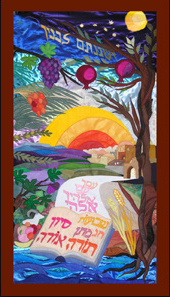
"Shavuot" Tapestry by Bracha Lavee
Shavuot [Pentecost], a festival tucked away in the middle of the year and likely to be forgotten by secular Jews if not for the abundant assortment of cheesecake and blintse recipes, is actually a rich source of folklore and folksongs reflecting agricultural festivity and the mysticism of revelation. (See, for example, "Shavuot: Beyond the Cheesecake").
The different names of the festival highlight its various aspects.
1. The names Festival of the First Fruits [Chag habikurim] and Harvest Festival [Chag hakatsir] reflect the fact that Shavuot was originally an agricultural festival - "You shall observe the festival of the harvest, the first fruits of your labors, which you will sow in the field…" (Shemot [Exodus] 23:16). The Mishnah (Bikurim, C.2-4) gives a detailed account of the procession of people bearing their first fruits to the Temple: "The inhabitants of the district assembled in a city of the district and spent the night in the town square. Early in the morning, their leader said: 'Let us rise and go up to Zion, to the house of the Lord our God.' Those who lived near Jerusalem brought fresh figs and grapes, and those who lived far away brought dried figs and raisins. . . . The sounds of the flute announced the pilgrims’ coming until they neared Jerusalem, when they sent messengers ahead and arranged their first fruits for presentation. The children's song Saleinu al k'tefeinu [Our baskets on our shoulders] by Levin Kipnis and Yedidya Admon (1929) harks back to this ancient Biblical festival. It is this agricultural aspect of Shavuot that was highlighted in the early days of modern Israel, especially in kibbutz-inspired celebrations. Here is a medley of Shavuot songs, followed by a traditional dance song, "Shiboleth basadeh" [Stalk in the field], sung by South African queen of song, Miriam Makeba. For more songs, here is a site including lyrics of the many agriculturally-based folksongs with English transcriptions.
2. The names Festival of Weeks [Chag haShavuot] and Solemn Assembly [Chag ha'Atseret] show that the festivalis also the culmination of the seven-week "Counting of the Omer", beginning on the second day of Pesach. This period was regarded as a count-down to the revelation on Mt. Sinai. According to Kabbalistic thought, the counting [sefirah] of the Omer promotes the radial influence of the seven Godly qualities [sefirot] with which man was endowed at Creation: chessed [kindness], gevurah [strength, empowerment], tiferet [beauty], netzach [infinity], hod [gratitude], yesod [foundation]and malchut [kingship]. This idea is expressed in the prayer Ribono shel olam - Ve'al yedei ze [May abundant bounty thereby be bestowed upon all the worlds] - the prayer recited after the counting of the Omer.
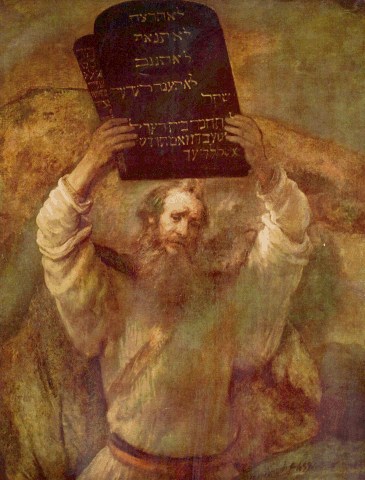
[Rembrandt, 1659]
In Sephardic communities, a ketubah (the certificate the bridegroom presents to the bride at the Jewish wedding ceremony specifying the conditions agreed upon between the two parties) is recited in the Shavuot service prior to the reading of the Torah. The version commonly used, Ketubah le-Shavuot - "Yarad dodi legano" is that of Rabbi Israel Najara (c.1550-c.1625) - see the the video below. A copla in Ladino, "La Ketuba de la Ley" [The marriage contract of the Law] (also known as "Es razon de alavar"), written by Yehuda bar Leon Kalay (d.1782), expresses the same idea. A Yiddish folksong, "Der eybershter iz der mekhutn" [the Almighty was the bride's father] expresses the idea of marriage between the people of Israel [Am Yisrael] and the Torah; God is represented as the bride's father [mekhutn] and Moshe is the matchmaker [shadkhn].
Ashkenazi communities recite Akdamut [Introduction], an Aramaic-language piyut describing how the angels praise God, while Sephardic and Mizrachi communities recite the piyut Azharot [Admonitions], enumerating the 613 commandments found throughout the Torah, by Solomon Ibn Gabirol (1021-1058).
An all-night vigil of Torah learning, Tikkun Leil Shavuot, was originally practised by the Kabbalists in the 16th century. According to the "Zohar", the Kabbalistic "Book of Splendour", the word "tikkun" has two meanings: "repair" and "decoration". Studying the Torah was a means of "repairing" the Tablets of the Law, which had been smashed following the sin of the golden calf; the 24 books of the Law were the "jewels" with which God's celestial bride, the Torah, were "decorated". The concept of Tikkun Olam [Repairing of the world] applies both to Kabbalistic mysticism and to the concept of social justice, which is central to all streams of Judaism.
Nowadays, variations of study on the night of Shavuot are observed by secular as well as orthodox Jews. From the musical point of view, Hasidim sing exuberant songs of faith, e.g., "Torah tsiva lanu Moshe" [Moshe commanded us to study the Torah] as well as niggunei devekut, i.e., slow, meditative melodies, expressive of yearning for union with the Divine, e.g., "tsomah lecha nafshi" [My soul thirsts for you].
Songs which celebrate the giving of the Torah abound: there is no lack of piyutim in Hebrew (e.g., "Ashorer shira lichvod hatorah" [I shall sing a song in honour of the Torah]) or popular Hebrew hasidic songs which are sung on the festivals of both Shavuot and Simchat Torah (see Shavuot Songs). Coplas in Ladino include "Muestro senor Elokenu" [Our Lord God] and "Hi torah lanu nitana" [It is the Torah which is given to us].
The importance of learning Torah in the life of the Jewish child is described in children's songs - La Torá, La Torá in Ladino, and, in Yiddish, Oylem Habe [The World to Come] or Shvues, libe kinderlekh [Shavuot, dear children]. A modern song, "Etslenu bikfar Todra" [In the village of Todra] by Habreira Hativit, shows the same tradition in Morocco.
The Jewish truism that "Toyre iz di beste skhoyre" [Torah is the best merchandise] is expressed in many Yiddish songs, particularly the lullaby "Unter dem kinds vigele" [Under the child's cradle].
Toyre iz di beste skhoyre, by Sholem Secunda
Besides the seminal idea of a marriage contract, there are many midrashim associated with the giving of the Torah. One is a dialogue between Moses and the angels, expressed in the copla "Alli en el midbar" [There in the wilderness], in which Moses is required to justify to the angels why the Jewish people deserve the Torah and why he, a mortal, should be allowed to approach God.
The Book of Ruth is recited during the Shavuot service. Ruth's moving plea to her mother-in-law Naomi - Al tifge'i vi le'ozvech [Entreat me not to leave thee; Whither thou goest] (Ruth 1, 16) - has long been a source of religious and musical inspiration for both Jews and Christians.
Here are two images of Ruth and Naomi gleaning: a photograph by Adi Nes (2006) and a painting by Chagall (1960):
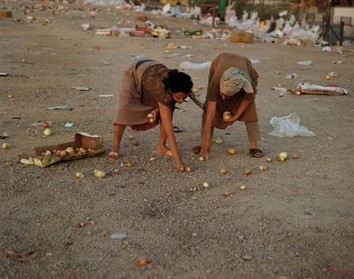
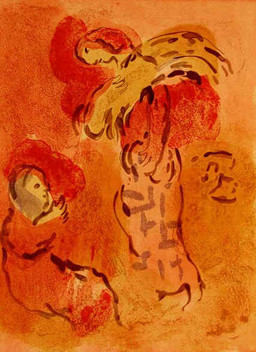
Here are some other famous paintings of Ruth and Naomi. Ruth was privileged to become great-grandmother of King David - ne'im z'mirot Israel [sweet singer of Israel] - the anniversary of whose death is commemorated on Shavuot.
.jpg)
The Torah is described in many metaphors. It is likened to milk and honey, as in the verse, "Honey and milk [the Torah] lie under your tongue" (Song of Songs 4:11), and it is also compared to water, wine, bread, oil and trees. Most significantly from the point of view of the folksinger is the metaphor of song.
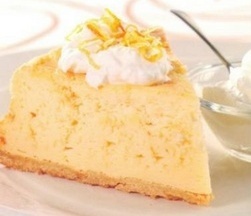
I began this overview mentioning the custom of eating milk-based products on Shavuot ("Why do Jews eat milk and dairy products on Shavuot?").1 Some of these traditional Shavuot foods are mentioned in the songs "Akh, vi gut s'iz tsu zayn a yid" [How good it is to be a Jew] and "Yidishe maykholim". A Biblical phrase mentioning "milk" has been popularized in song - "Erets zavat khalav ud'vash" [a land flowing with milk and honey] - and sounds especially sweet when sung by Nina Simone (who learnt it from Shlomo Carlebach).
* * * * *
* * * * *

§ Links to Shavuot Sites in English
OU.org
Scenes of Shavuot from Salonica to Seattle
Shefa Shavuot
Shavuot as feast of mystical revelation (scroll down)
The Shavuot marriage contract

